









In Depth
Statistics and trends at the UPC
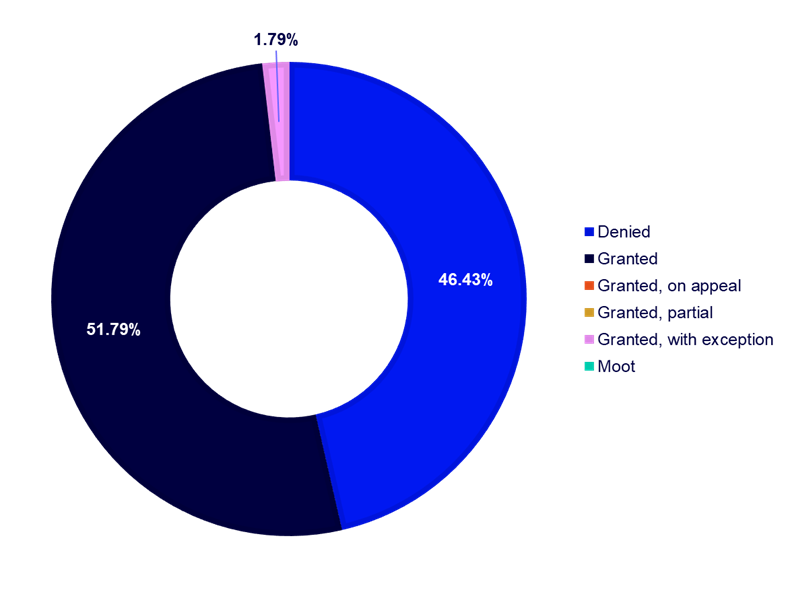
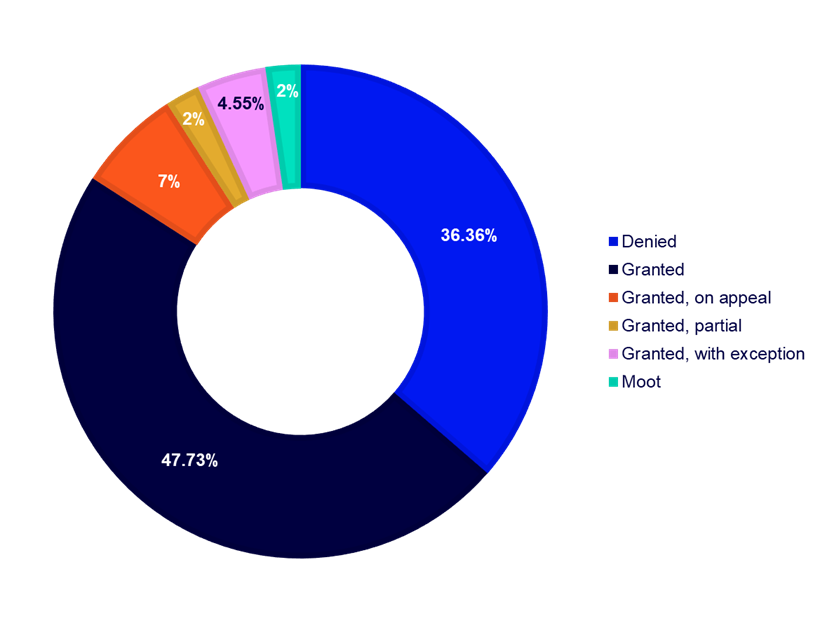
Early statistics suggest that the UPC has taken a relatively patentee-friendly approach when it comes to injunctions. Overall, the success rate for preliminary injunctions exceeds 60%, while patent holders have a little more than a 50% chance of receiving a permanent injunction on the merits. These outcomes are rather high compared to US cases, where injunctions have become much more difficult to obtain.[1] In this respect, given the demanding evidentiary standard, patentees seem to request such preliminary measures only when they are confident in the strength and urgency of their claims.
Success rates for preliminary and permanent injunctions at the UPC
Status of permanent injunctions
Status of preliminary injunctions
Despite the court’s relative newness, distinct patterns are already emerging among the Local Divisions.
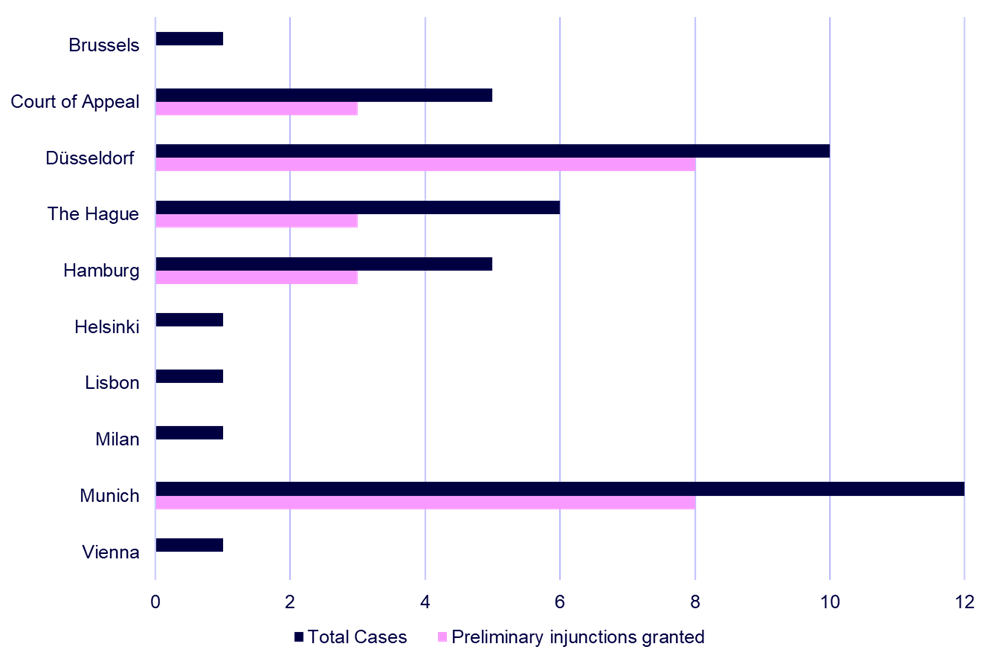
For example, the Local Divisions in Germany have shown a rather patentee-friendly stance. In this respect:
- The Local Division Düsseldorf has granted approximately 80% of the requests for preliminary injunction.
- The Local Division Munich follows, with around 67%.
- Of the 21 preliminary injunctions granted, 62% were issued by the Local Divisions located in Germany.
At the CoA level, approximately 60% of the preliminary injunctions have been granted.
Preliminary injunction grant rates by division and appeal outcomes
Legal test for preliminary injunctions
Because of the potential extraordinary impact of these preliminary measures – they carry the immediate power to either halt commercial activities or permit them to continue – the UPC applies a strict legal test to ensure that interim relief is justified. This test, rooted in Article 62 UPCA and Rule 211 of the UPC’s Rules of Procedure (RoP), defines the substantive and procedural thresholds applicants must meet to obtain a preliminary injunction.
Under Article 62(4) UPCA and Rule 211(2) RoP, the applicant must demonstrate, to a sufficient degree of certainty, that it is entitled to bring the action pursuant to Article 47 UPCA, that the patent is valid or likely to be valid, and that there is an (at least imminent) infringement.
Even where these criteria are met, the court shall, pursuant to Article 62(2) UPCA and Rule 211(3) RoP, “have the discretion to weigh up the interests of the parties and, in particular, to take into account the potential harm for either of the parties resulting” from whether or not the provisional measures will be ordered.
In order for a preliminary injunction to be granted, the court must be satisfied that it is more likely than not that these elements are met (see CoA in Boehringer Ingelheim v. Zentiva, NanoString v. 10x Genomics, and Mammut v. Ortovox).
After more than two years, the CoA and Local and Regional Divisions have further clarified these criteria.
Imminence of infringement
The requirement of “imminence,” assessed under Articles 62(1) and (4) UPCA and Rule 211(2) RoP, is met by situations where the infringement has not yet occurred but where the alleged infringer has ‘set the stage for it to occur’, as clarified in Boehringer Ingelheim v. Zentiva. Accordingly, preliminary injunctions may be ordered to prevent infringement when the allegedly infringing product has not yet been launched.
In the same case, the CoA held that, in the context of generic products, the mere application for or grant of a marketing authorization does not constitute imminent infringement. However, completion of national pricing and reimbursement procedures may amount to imminent infringement when no further steps are required before market entry.
This approach was later extended to medical devices in the case Occlutech v. Lepu, where the Local Division Hamburg found that obtaining and publicly announcing CE marking under the medical device regulation, combined with marketing efforts or participation in trade fairs, constitutes evidence of imminent infringement, as this demonstrates both regulatory readiness and a concrete intent to market within the European Union.
Urgency
The requirement of “urgency” derives from Rule 211(4) RoP, where the court must consider any “unreasonable delay in seeking provisional measures.”
The CoA has repeatedly clarified that the reasonability of a delay depends on the circumstances of each case. The relevant period is when the applicant becomes aware, or should have become aware, of the facts justifying interim relief. More precisely, the decisive point is when, after exercising due diligence, the applicant possesses the necessary evidence to support a reasonable prospect of success (Mammut v. Ortovox).
For instance, in Boehringer Ingelheim v. Zentiva, urgency was satisfied when the application was filed approximately one month after public notification of the generic’s pricing and reimbursement approval. Similarly, in Dyson v. SharkNinja, the Local Division Munich accepted a two-month delay after the detection of sales, though the preliminary injunction was later lifted by the CoA.
In Biolitec v. Lightguide, the Local Division Düsseldorf rejected the application for lack of urgency because the medical single-use product had been on the market for several years, well before the patent was granted in July 2024. The CoA confirmed this decision.
At the far end of the timeliness spectrum, the Local Division The Hague has accepted, in Amycell v. redacted, an approximately 10-month delay to be justifiable, as the applicant needed time to obtain evidence on the specific strains, given the time-consuming nature of cultivation and to anticipate the defendant’s likely arguments. This illustrates how the facts and practical constraints of a case can influence the court’s assessment of temporal urgency.
Conversely, in Merz v. Viatris, the Local Division Paris denied provisional measures for lack of urgency because the applicant waited for an actual launch of generic products before seeking provisional measures. The Local Division Paris considered that Merz should have sought such measures at an earlier stage when Viatris had completed all regulatory steps, i.e., when the subsequent launch became imminent and possibly undeniable. In other words, innovators seem to have only one shot at preliminary measures, with no second chance if the patentee waits until actual launch before starting any action. This is the second decision to go in that direction, after Cilag v. Rivolution from Local Division The Hague. Market entry does not seem to revive urgency.
Necessity
Under Rule 206(2)(c) RoP, “necessity” requires the applicant to explain why provisional measures are essential to prevent infringement. The CoA has confirmed that this is a material, not formal, requirement (NanoString v. 10x Genomics; Biolitec v. Lightguide).
Necessity will generally be established where any delay would cause irreparable harm or where only interim relief can provide effective protection. Although irreparable harm is not a mandatory criteria (Mammut v. Ortovox; Biolitec v. Lightguide), it often plays a decisive role, particularly in cases of direct competition (Biolitec v. Lightguide) and risk of price erosion (Insulet v. EOFlow). The CoA has also emphasised that evidence of clear infringement and a high probability of validity alone are insufficient; applicants must show why only interim relief can ensure effective protection (Biolitec v. Lightguide). In Boehringer Ingelheim v. Zentiva, the CoA found the requirement of necessity satisfied due to the risk of permanent price erosion and market substitution resulting from a generic product priced at least 30% lower. Similarly, in Biolitec v. Lightguide, the court emphasized that applicants must show that interim relief is required to protect market share, prices, or other interests that cannot await a decision on the merits.
Parallel US litigation and strategic considerations
Of the UPC cases considered, 14 had parallel litigation in the United States involving related patents. Only two of those cases resulted in permanent injunctions (done by stipulation of the parties). Of the remaining 12 US cases, eight settled on undisclosed terms, two resulted in the finding of noninfringement or invalidity, and the remaining cases are still pending. Only one case involved preliminary injunctions in both the US and the UPC (Alexion Pharmaceuticals v. Samsung Bioepis[2]), but both the US District Court and the UPC rejected the patent owner’s request (by Alexion) for the preliminary injunction based on invalidity concerns. Although it is too early to extract any definitive general trends from these few parallel cases, as discussed below, the increased threat of an injunction in Europe relative to the US and the UPC’s shortened timeline does appear to be affecting strategic decision making.
For example, in three of the settled cases,[3] the strategy of litigating parallel cases in the US and at the UPC played a role in the outcome. In each case, the US litigation was in the early stages when the UPC reached decisions on preliminary measures. And in each case, the denial of a preliminary injunction at the UPC resulted in a global settlement resolving the UPC and the parallel US litigation. This shows the effect that the UPC’s shortened timeline has on global enforcement strategies. Seeking a preliminary injunction at the UPC gives parties an early indication of the likelihood of success, incentivizing them to make strategic decisions early in the case about whether to proceed with the case or settle. Moreover, as discussed herein, the chance of success in seeking a preliminary injunction at the UPC is relatively high, at around 60%.
In another notable case, Edwards Lifesciences v. Meril Life Sciences,[4] the patentee filed parallel litigation in the US and at the UPC. The parallel cases involved products from Meril’s Myval line of prosthetic heart valves and delivery systems. Meril’s Myval systems have received regulatory approval in Europe but have not yet been approved by the US Food and Drug Administration. As such, the UPC case involved the commercial sale of products in Europe, whereas the parallel US litigation addressed the products in pre-commercial state, specifically importation for a medical conference in association with seeking regulatory approval. In the US, the court denied relief based on the Hatch-Waxman safe harbor of 35 US Code (USC) § 271(e)(1), which allows the use of patented material solely for purposes reasonably related to obtaining regulatory approval.[5] But in the UPC, Edwards obtained broad injunctive relief based on findings of infringement, far earlier than would have been available in the US.
In another situation, Headwater Research sued Samsung Electronics in multiple cases in the US and at the UPC. In one US case, Headwater won a jury verdict of $278 million,[6] which led to settlement of related cases. However, Samsung succeeded on a counterclaim for revocation at the UPC with the court finding that Headwater added new matter during prosecution. While these results partially reflect the difference in prosecution standards between US and European patents, they also highlight the differences in how each jurisdiction approaches validity in litigation and how one can be deployed to impact the other. The parallel revocation action in the UPC served to put downward pressure on the overall economics of the dispute, potentially lowering the amount at stake.
Accordingly, early data suggests that there are strategic advantages in litigating parallel cases in the US and at the UPC. In general, the UPC’s condensed timeline relative to US courts allows parties to get an early indication of strength of case and positions, and potentially leverage early wins in settlement negotiations.
Conclusions
The UPC applies a substantive, evidence-driven test for preliminary injunctions, close to a merit-level analysis by analyzing patent validity. Applicants must present a comprehensive case demonstrating validity, infringement, imminence, urgency, and necessity. In addition to the substantive merits, courts carefully assess the urgency and necessity of interim relief before granting it. In general, preliminary injunctions in the UPC have had about a 60% success rate, which is far higher than is found in US cases. Permanent injunctions remain a standard form of final relief in UPC cases. Case strategies that integrate both US and UPC parallel actions have the potential to leverage the comparative advantages of each jurisdiction, potentially leading to more efficient case resolutions.