









In Depth
Merger notification threshold changes
The HSR premerger notification regime requires transacting parties to notify the FTC and US Department of Justice (DOJ) of their intent to consummate a transaction that meets or exceeds certain jurisdictional thresholds, unless an exemption applies. The adjusted thresholds apply to all transactions that close on or after February 17, 2026.
The HSR thresholds are adjusted annually based on gross national product (GNP). The threshold changes are as follows:
- The base statutory size-of-transaction threshold, the lowest threshold requiring notification, will increase to $133.9 million.
- The upper statutory size-of-transaction test, requiring notification for all transactions that exceed the threshold (regardless of the size-of-person test being satisfied), will increase to $535.5 million.
- The statutory size-of-person lower and upper thresholds (which will apply to deals valued above $133.9 million but not above $535.5 million) will increase to $26.8 million and $267.8 million, respectively.
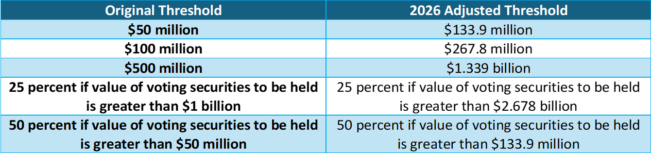
HSR notification thresholds for acquisitions of voting securities
After an HSR filing has been made, and the applicable waiting period has expired or been terminated, any additional acquisitions by the same acquiring person of the same issuer’s voting securities will be exempt from HSR notification, so long as:
- The acquiring person’s holdings crossed the notification threshold with respect to which the premerger notification was made within one year of the expiration or early termination of the HSR Act waiting period; and
- The subsequent acquisition is consummated within five years following the expiration or early termination of the HSR Act waiting period; and
- The subsequent acquisition will not meet or exceed a higher notification threshold (based on the adjusted thresholds in effect at the time of consummation).
HSR filing fee changes
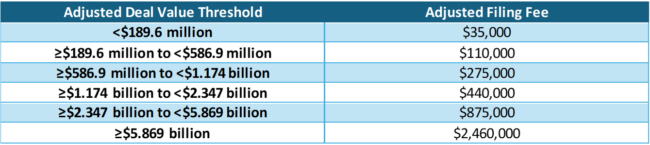
The FTC is also required to update filing fee thresholds and amounts on an annual basis. Filing fee thresholds are adjusted based on the percentage change in GNP and filing fee amounts are adjusted based on the percentage change in the Consumer Price Index. These changes will also take effect February 17, 2026.
The adjusted filing fee thresholds and fee amounts are provided in the table below.
Revised thresholds for interlocking directorates
The FTC also revised the thresholds for evaluating interlocking directorates, effective as of their date of publication in the Federal Register. Under certain circumstances, Section 8 of the Clayton Act prohibits one person from simultaneously serving as a director or officer of two competing corporations if each corporation has capital, surplus, and undivided profits aggregating more than $54,402,000.
The Clayton Act does not prohibit the interlock if (1) the competitive sales of either corporation are less than $5,440,200; (2) the competitive sales of either corporation are less than two percent of that corporation’s total sales; or (3) the competitive sales of each corporation are less than four percent of that corporation’s total sales.
Although Section 8 technically applies only to corporations, both the DOJ and the FTC have taken the position that they have the authority to enforce the same concept against non-corporate entities.